




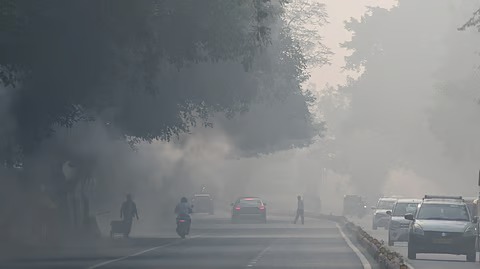
Delhi recorded its worst air quality in 287 days on Tuesday, November 3, as the Air Quality Index (AQI) climbed to 350, pushing several parts of the capital into the severe pollution category. The city last recorded a higher AQI on January 20, when the index stood at 378.
Of Delhi’s 57 air quality monitoring stations, 10 reported severe pollution, 35 recorded very poor air quality and 12 fell in the poor category. Jahangirpuri recorded the highest AQI at 462. PM2.5 was the dominant pollutant, with fine particles capable of penetrating deep into the lungs and entering the bloodstream.
The Air Quality Early Warning System forecast that pollution levels would remain in the very poor category until November 6, with conditions likely to persist between very poor and severe over the following six days. Delhi was placed under Stage II of the Graded Response Action Plan (GRAP) on Monday, after its AQI reached 324.
Farm fires are expected to contribute more significantly to the city’s pollution in the coming days. The Ministry of Earth Sciences’ Decision Support System forecast that stubble burning’s contribution to Delhi’s PM2.5 pollution would rise from 8.5% on November 2 to 22.2% by November 5.
Satellite data detected 219 paddy residue-burning incidents across monitored states on November 2, including 98 in Punjab, 67 in Rajasthan and 48 in Madhya Pradesh. Between September 15 and November 2, a total of 3,535 farm-fire incidents were recorded across seven states and Delhi. Punjab accounted for 1,612 cases, followed by Rajasthan with 738 and Madhya Pradesh with 614.
Despite the seasonal fires, the data indicates a substantial long-term decline in incidents. The corresponding period recorded 51,822 fires in 2020, compared with 4,993 in 2025.
Meanwhile, NCRTC is adding 20 trips to the Delhi-Meerut Namo Bharat corridor from Wednesday, covering the route between Sarai Kale Khan and Modipuram. The move is intended to encourage public transport use and reduce dependence on private vehicles as air quality deteriorates.
Source: The New Indian Express