




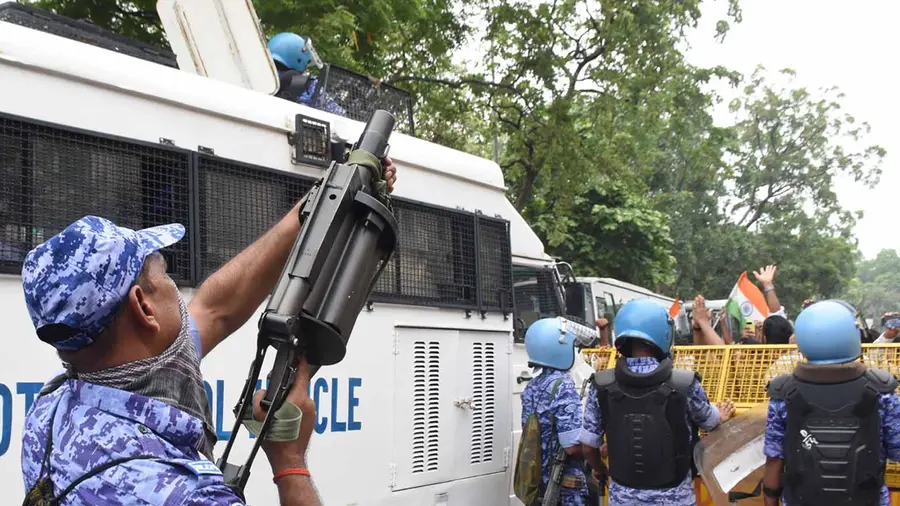
An ex-IPS officer and two victims injured by pellet gun fire have moved India’s Supreme Court seeking a complete ban on the weapons and compensation for past injuries. The petition, reported by Mint, challenges the use of pellet guns as a tool for dispersing civilian assemblies, arguing the weapons are fundamentally unreliable and dangerous.
The core argument in the petition is straightforward: once pellet guns are fired, the trajectory of the projectiles becomes sporadic and unpredictable. Officers cannot reliably control where the pellets will travel or who will be hit. This unpredictability, the petition argues, makes pellet guns unsuitable for use on civilians in any context. The involvement of an ex-IPS officer suggests this criticism comes not just from victims, but from people with direct knowledge of law enforcement operations.
Pellet guns have been a standard crowd control tool for Indian police and paramilitary forces for decades. When fired, they release hundreds of small metal balls designed to injure rather than kill. The underlying logic is that they offer a middle ground between traditional lathi charges and lethal force. However, this logic breaks down when the weapon itself cannot be controlled with precision.
The human cost of this imprecision is documented. Pellet gun injuries have caused permanent blindness in multiple cases, particularly in Kashmir where the weapons have been used extensively during civil unrest. Victims have faced lifelong disabilities from wounds inflicted during moments of protest. The two victims named in this petition represent countless others who have suffered similar harm.
The petition raises a constitutional question: does the government’s use of unpredictably dangerous weapons on civilians violate the right to bodily safety guaranteed under the Indian Constitution? It also asks whether such weapons meet the test of reasonableness required for any police action. If the Supreme Court accepts these arguments, it would force the government to either stop using pellet guns or explain why an arbitrary and dangerous weapon serves a legitimate public purpose.
Beyond the immediate question of pellet guns, this case touches on a larger issue: what methods should police use to manage crowds in a functioning democracy? The petition is also seeking compensation for those already injured, which would establish financial accountability for past use.
Source: Mint