



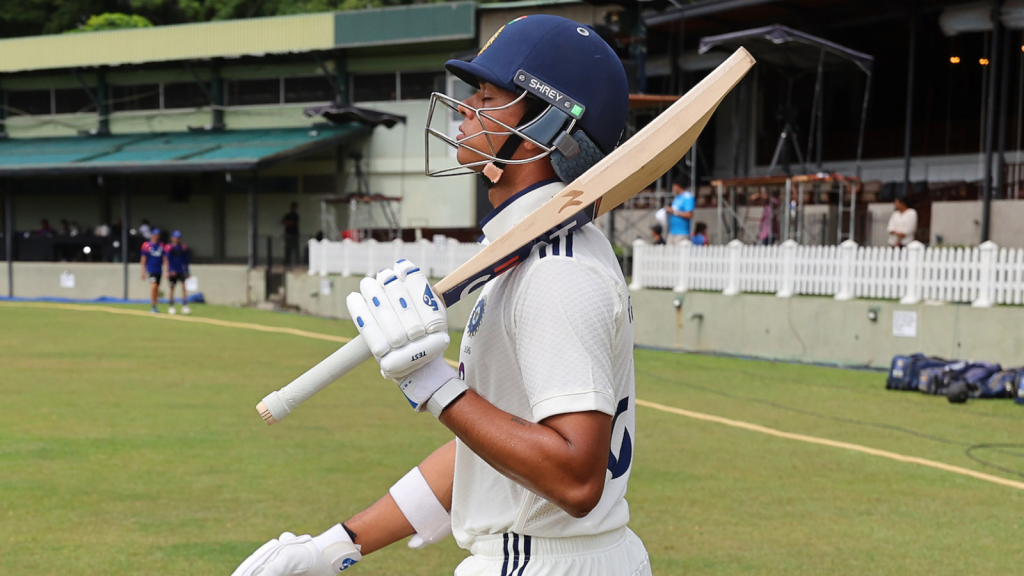
For Yashasvi Jaiswal, the first Test against Sri Lanka in Galle will be another test of a skill that has defined his young career: knowing when to attack and when to wait.
Jaiswal has shown that he can switch between defence and aggression, but the line between the two has occasionally been difficult to judge. In Sri Lanka, where conditions can change rapidly, that judgement could determine how far he goes.
Batting in Asia is not always as straightforward for openers as it may appear. The new ball and fresh surface can offer an opportunity, but Sri Lankan pitches can also produce movement early or turn unexpectedly. Former Sri Lanka opener Dimuth Karunaratne described Galle as one of the toughest places to bat because it can be difficult to establish whether seam or spin will pose the bigger threat.
That uncertainty makes Jaiswal’s decision-making particularly important.
His 209 against England in Visakhapatnam in 2024 offers a blueprint. With India losing wickets regularly at the other end, Jaiswal resisted the urge to force the pace, scored at a measured rate and gradually expanded his attacking range. He remained positive without allowing the situation to dictate his shot selection.
There have also been innings where the balance has proved harder to maintain. Against New Zealand in Bengaluru later that year, Jaiswal moved from 10 off 30 balls to 35 off 52 after settling in, only to charge down the track against Ajaz Patel and get stumped. His cut shot tells a similar story. It is among his most productive strokes, but has also contributed to eight dismissals.
He showed both sides of his game in the warm-up match, hitting 61 off 46 balls in the second innings. He scored freely when he could get on top of the bounce but found things more difficult when the ball stayed low.
Jaiswal has scored 1,417 runs in 15 Tests since his debut in July 2023, averaging 54.50 with three centuries. Those numbers have all come in India, making Sri Lanka an important opportunity to demonstrate that his game can travel within Asian conditions too.
In Galle, the conditions may demand something different from him as the day progresses. A ball that can be driven or cut in the morning may become a different proposition later, particularly as the surface wears.
For Jaiswal, the challenge is therefore not to suppress the aggression that has made him successful. It is to make it more selective. In Sri Lanka, the ability to recognise when a Test match is asking him to attack and when it is asking him to wait could be just as important as the strokes themselves.