



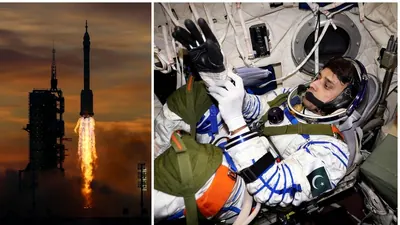
China launched its Shenzhou-24 crewed spacecraft on Wednesday, carrying three astronauts, including Pakistani national Muhammad Zeeshan Ali, the first foreign astronaut to participate in China’s crewed space programme.
The spacecraft, mounted on a Long March-2F carrier rocket, lifted off from the Jiuquan Satellite Launch Centre in northwest China. Officials declared the launch successful shortly after liftoff. The spacecraft is expected to dock with China’s Tiangong space station approximately three hours after launch.
The crew comprises mission commander and spacecraft pilot Tang Hongbo, flight engineer Wu Yi and Ali. His participation marks the first time a foreign astronaut will visit the Chinese space station, which became operational in 2022.
Ali is expected to spend around a week in orbit before returning to Earth aboard the Shenzhou-23 spacecraft. Chinese astronauts, by comparison, typically remain aboard Tiangong for approximately six months.
The mission will involve a crew rotation with the astronauts currently aboard the station, alongside routine maintenance and scientific research. Chinese officials said more than 90 scientific experiments and technology tests are planned during the mission.
The research will cover several areas, including space life sciences, materials science, microgravity fluid physics, combustion science, fundamental physics, space medicine and emerging space technologies. The crew will also undertake maintenance work, public outreach activities and payload tests.
China developed its own space station after being excluded from the International Space Station programme, reportedly over concerns about the involvement of its military, the People’s Liberation Army, in its space activities. Tiangong is currently the only operational space station owned and operated by a single country.
The International Space Station, which has hosted astronauts from multiple countries and thousands of experiments since 1998, is expected to be retired in early 2031, according to reports. NASA plans to use a dedicated deorbit vehicle being developed by SpaceX to guide it towards a controlled re-entry over the South Pacific.
Source: Business Standard (Press Trust of India)