




Three months before deadly flash floods struck along the Nepal-Tibet border, Nepal had already asked China for information on glacier movements and other risks that could help authorities prepare for extreme events.
Nepali and Chinese officials met in Kathmandu on May 27 to discuss cooperation on floods, weather and glacier-related hazards. The meeting involved 10 Nepali officials and roughly a dozen Chinese officials. Among the measures discussed were inventories of glacial lakes, hazard mapping and stronger systems for sharing information.
Nepal’s Flood Forecasting Division said it specifically wanted early information on glacier movements, including changes that could signal an impending hazard.
China later said it had shared information “in a timely manner,” according to Reuters. But the glacier movement data Nepal had requested was not included in the information it received.
China did provide Nepal with heavy-rain forecasts for Tibet about a month before the disaster, sending the information through WeChat and email. Twelve days before the August 26 floods, China’s World Meteorological Centre also warned Nepal of enhanced rainfall and possible cascading hazards.
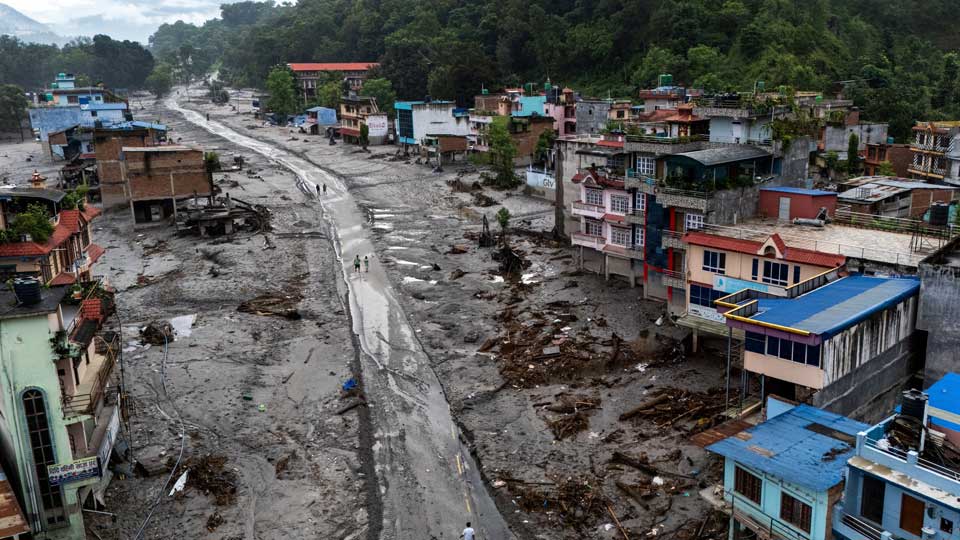
The disaster that followed was linked to a glacier collapse in a relatively unmonitored area. An estimated five million cubic metres of ice and rock collapsed, triggering a flood that carried roughly 57.4 million cubic metres of water.
The scale of the destruction was severe. At least four monitoring stations across 168 kilometres were destroyed, 19 bridges were damaged and around 40 kilometres of highway were wiped out. More than 10% of Nepal’s power-generation capacity was also knocked out.
More than 800 people died, while over 3,000 remain missing, including 275 Indians.
Nepal is now seeking glacier-related information from China every 10 minutes. It also plans to propose a new data-sharing agreement modelled on its existing arrangement with India.
The episode has put a sharper focus on a problem facing Himalayan countries: glacier hazards can develop in areas where monitoring remains limited, making timely cross-border information critical to early warning and disaster preparedness.
Source: Reuters