



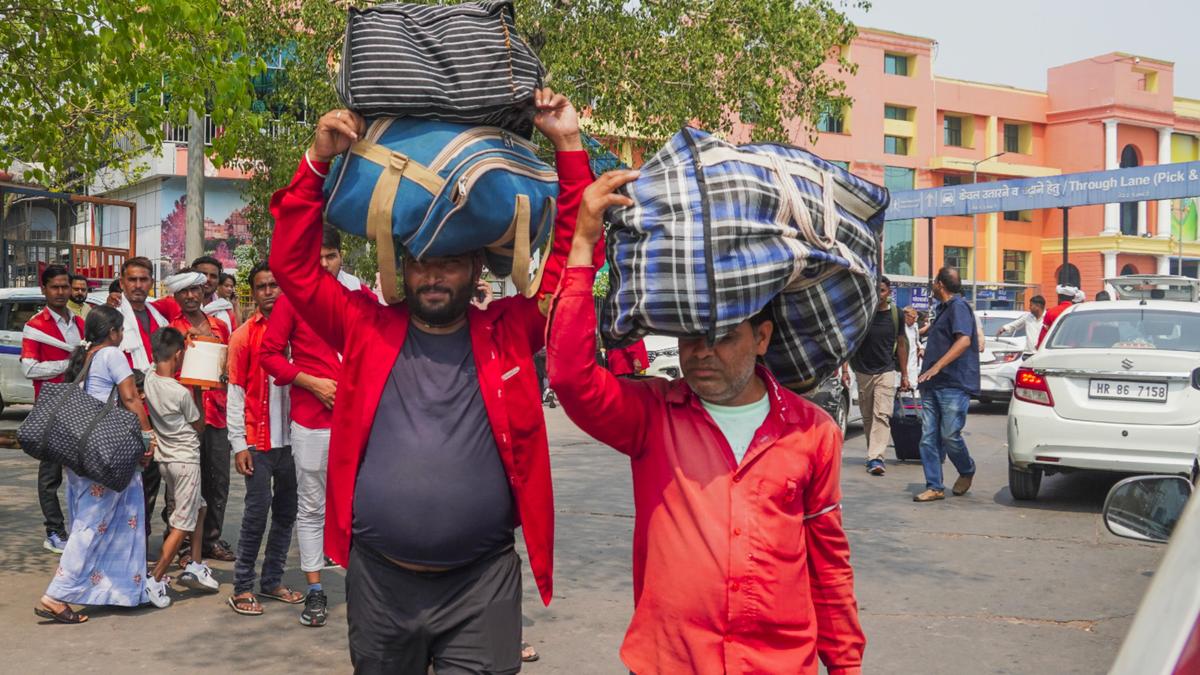
Across Indian railway stations, the work of porters is quietly disappearing. A porter in Uttar Pradesh told The Hindu that newer infrastructure, installed over the past 15 years, has “practically wiped out” their job. Lifts and escalators now move passengers and luggage. Wheeled suitcases, once rare, are now standard. The result is stark: porter earnings have fallen to roughly 200 rupees per day, down from double that amount.
This is modernisation with an unintended consequence. When railway stations installed lifts and escalators to improve accessibility and safety, fewer porters were needed. The work that remained became irregular and seasonal, concentrated around holiday rush. An estimated 50,000 porters work at Indian railway stations, but no government data tracks their numbers or income decline. This absence of counting reveals an absence of planning.
The problem is not modernisation itself. Lifts and escalators make stations safer for elderly passengers, people with disabilities, and families with young children. Wheeled luggage improves travel experience. These changes are net positive for most users. The gap exists elsewhere: nobody planned what would happen to the people whose labour became unnecessary.
When large corporations modernise operations, they typically implement transition programmes. Workers receive retraining for new roles, job placement support, or exit packages. Railways, one of India’s largest employers with resources comparable to any corporation, have not done this for porters. No formal retraining. No guaranteed alternative employment. No transition support. Workers were simply left to manage the decline themselves.
This creates a cascading problem. Without support, some porters migrate to other cities seeking informal labour that often pays less. Some drop out of formal employment records entirely, becoming neither officially employed nor unemployed. Their families lose income security. Their children face educational disruption. The cost of modernisation is borne entirely by people least able to absorb it.
The railways modernised infrastructure because it made sense to do so. But modernisation that leaves 50,000 workers without a path forward is incomplete. It solves a problem for passengers while creating an unaddressed human problem that grows quietly, untracked and invisible in official statistics.
What happens next depends on whether railways view displaced workers as a cost of progress or as people who contributed to the institution and deserve support through change. That choice has not yet been made.
Source: The Hindu