




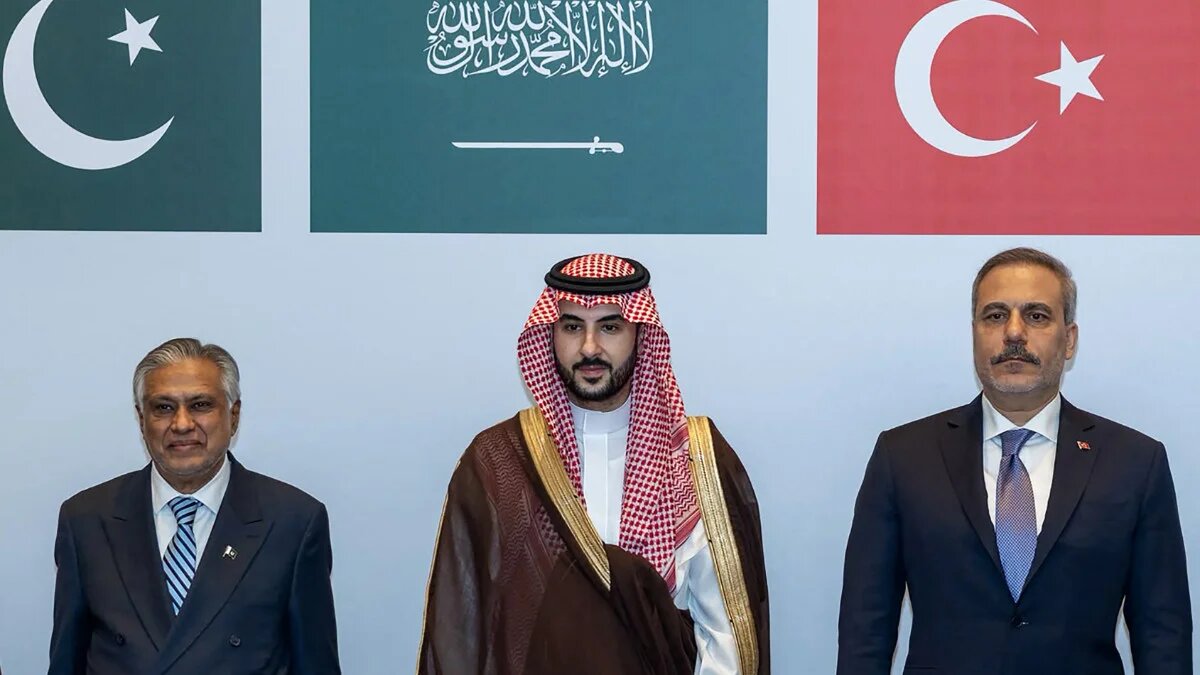
Saudi Arabia, Turkey and Pakistan have activated a joint defence agreement called the Makkah pact for the first time, responding to intensified attacks by Yemen’s Houthi militia. The pact, signed in 2021, requires member countries to treat an armed attack on one nation as an attack on all, similar to NATO’s founding principle. The activation came after Houthi drones and missiles targeted Saudi Arabian oil infrastructure and ships in the Red Sea over recent weeks.
The three countries have positioned this move as proof that the pact works as a rapid-response alliance for Muslim-majority nations. Saudi Arabia, which hosts Islam’s holiest sites, leads the coalition. Turkey brings military firepower and strategic location bridging Europe and Asia. Pakistan contributes troops and air defence capabilities. Officials presented the joint response as a model for collective security in the Middle East and South Asia.
However, experts question whether these three nations actually share enough common interests for the pact to function like NATO long-term. NATO members are bound by decades of shared Western values, trade networks and Cold War history. The Makkah pact members, by contrast, have competing regional goals. Turkey and Saudi Arabia have clashed over Syria policy and influence in the Arab world. Pakistan and Saudi Arabia have historically strained relations over sectarian tensions. Turkey and Pakistan have limited economic ties and no shared borders.
The Houthi threat does provide an immediate reason for cooperation. The militia, backed by Iran, has escalated attacks on commercial shipping and Saudi targets. This creates a narrow window where all three countries see shared danger. Yet this military alignment does not address deeper strategic divides.
NATO’s strength lies in binding member economies together through trade and shared democratic institutions. The Makkah pact lacks these structural ties. Member countries still pursue separate foreign policies in Syria, Iraq and Afghanistan. They have different relationships with Iran, despite its role in fueling Houthi capabilities. Pakistan maintains diplomatic channels with Iran; Saudi Arabia and Turkey do not.
The activation also faces questions about enforcement. If the pact required Pakistan to deploy troops in Yemen or the Red Sea, would domestic politics allow it? Pakistan’s parliament and military leadership would need to approve overseas operations. Turkey’s involvement in Middle Eastern conflicts has historically drawn domestic opposition. These hesitations suggest the pact works best for symbolic coordination rather than binding military commitments.
The Makkah pact may prove durable as a crisis-response mechanism for immediate threats like Houthi attacks. It signals to Iran that Sunni-led countries can coordinate defence efforts. But calling it a “Muslim NATO” overstates its architecture and reach. It remains an informal security arrangement among three nations with overlapping but not identical interests, activated when a specific threat emerges.
Source: Mint