



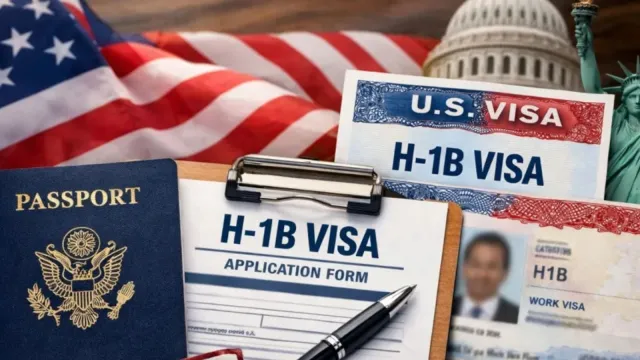
The United States has expanded an existing immigration fee to cover certain H-1B and L-1 visa extension petitions, increasing costs for employers that sponsor large numbers of foreign workers, including Indian professionals.
The new rule, issued by the Department of Homeland Security (DHS), extends the 9-11 Response and Biometric Entry-Exit Fee to qualifying extension-of-stay petitions. As a result, covered employers will now have to pay $4,000 for H-1B petitions and $4,500 for L-1 petitions when seeking to extend the stay of eligible employees. The rule takes effect on September 9, 2026.
The fee itself has not increased. Instead, the government has expanded the situations in which it applies. The rule affects employers with 50 or more employees in the United States, where more than half the workforce is employed on H-1B or L-1 visas, a threshold commonly known as the 50-50 rule.
The change is particularly relevant for Indian professionals. According to the US Citizenship and Immigration Services, beneficiaries born in India accounted for 71% of all H-1B petitions approved in fiscal year 2024, making them by far the largest group of H-1B workers in the country.
Although the additional fee is imposed on employers rather than employees, it adds to the cost of retaining skilled foreign workers. Companies that rely heavily on H-1B talent, particularly in the technology, consulting and IT services sectors, may have to factor the recurring expense into decisions involving visa renewals and workforce planning.
DHS estimates the expanded fee requirement will generate about $157.3 million annually to support the US biometric entry-exit programme. The department also clarified that the measure is separate from the proposed $100,000 H-1B fee announced by the Trump administration.
The latest rule does not change H-1B eligibility or visa quotas. Instead, it broadens when qualifying employers must pay an existing government fee, adding another compliance cost for companies that depend on skilled foreign workers while leaving the financial burden with employers rather than visa holders themselves.