




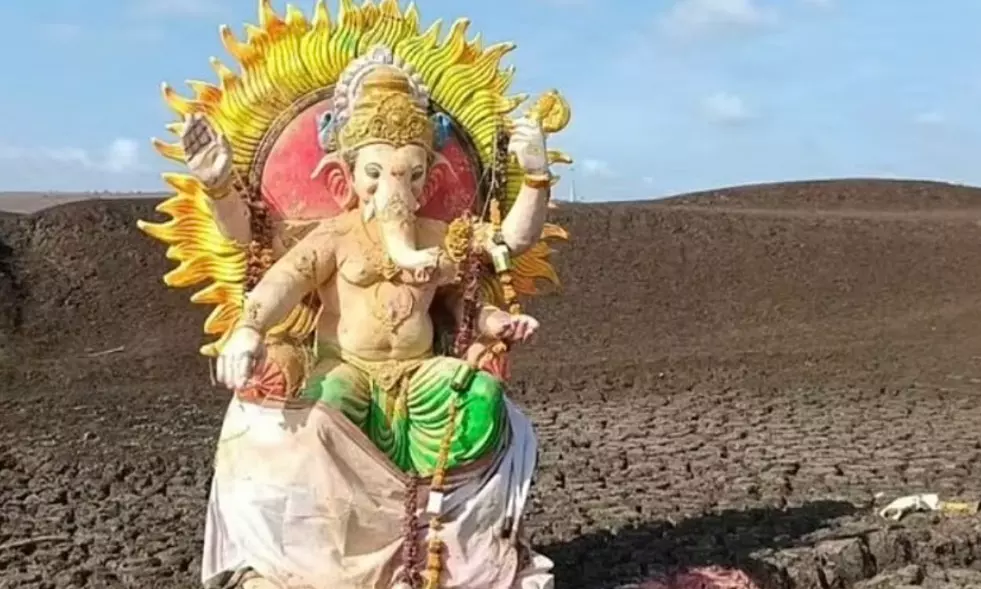
Parts of Andhra Pradesh are witnessing an unusual situation this Ganesh Chaturthi, with devotees leaving Vinayaka idols on dry riverbeds as water levels remain critically low across several regions of the state.
In Anantapur district, dry riverbeds and depleted water levels have left devotees with few options for the traditional Ganesh Visarjan, or idol immersion. Poor rainfall and drought-like conditions, reportedly linked to the El Nino effect, have left several rivers and water bodies without sufficient water for the ritual. The Chitravati river, one of the region’s key water sources, has completely dried out, forcing devotees to leave idols on dry land instead of immersing them. Similar scenes have also been reported near the HLC canal in Bukkarayasamudram.
The shortage is not limited to the Chitravati river alone. Several other regions across Andhra Pradesh are facing depleting water sources, making it difficult for local communities to carry out immersion ceremonies as planned. In some areas, residents have arranged water through tankers to fill ponds and enable idol immersion, while the broader shortage has renewed calls for authorities to identify alternative immersion sites in places where rivers, canals and ponds lack adequate water.
The issue has taken on a political dimension in the state. Former minister and YSR Congress Party leader Vellampalli Srinivas criticised the ruling TDP-led state government over its arrangements for Ganesh idol immersion, alleging that authorities were aware of the water shortages in advance but failed to create adequate alternatives for devotees. He questioned why temporary ponds could not have been set up or water arranged at designated immersion locations in drought-affected areas. Srinivas also alleged that organisers faced difficulties obtaining permissions for Ganesh pandals, prayers and community meals, or annadanam, in some parts of the state. These allegations form part of the YSRCP’s broader criticism of the government and have not been independently verified.
The situation has also revived discussion around the use of artificial immersion ponds, particularly in drought-prone or environmentally sensitive areas. Such facilities could offer devotees a designated immersion site while reducing pressure on already stressed natural water bodies, and align with existing environmental guidelines that discourage the use of materials like Plaster of Paris and chemical colours in immersion rituals.
(Source: OneIndia)