




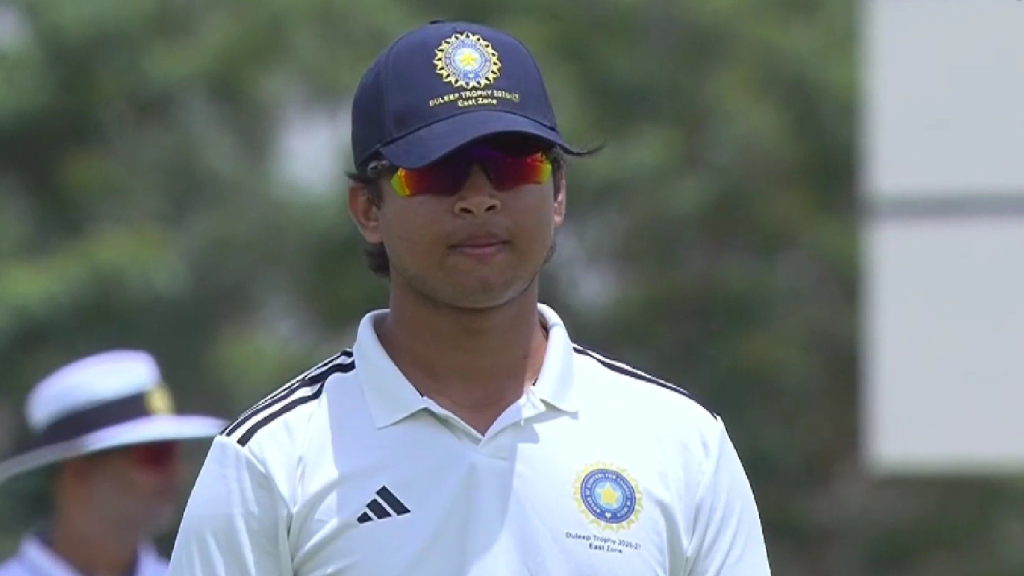
Vaibhav Sooryavanshi has already achieved more at 15 than most cricketers do in an entire career. His rapid rise through T20 cricket has now prompted a different question: can the teenager eventually build a game suited to all three formats?
Former England spinner Monty Panesar has his doubts. Speaking on the Beyond23 Cricket Podcast, Panesar said he could not currently see Sooryavanshi making the transition to Test cricket, pointing specifically to concerns over his technique. He cited England’s Harry Brook as a rare example of a player currently ranked among the best in both Test and T20 cricket.
The assessment comes against the backdrop of Sooryavanshi’s remarkable T20 numbers. He has scored 1,670 runs in T20 cricket at an average of 42.82 and a strike rate of 216.32, while his First-Class record stands at 399 runs from 17 innings at 23.47.
There is, however, another side to his red-ball record. Sooryavanshi’s career-best First-Class score of 93 came in East Zone’s Duleep Trophy semi-final against Central Zone in Bengaluru last month. He also became the youngest batter to score a Duleep Trophy fifty, reaching the landmark at 15 years and 157 days.
Former Australia captain Michael Clarke has taken a very different view of the teenager’s prospects. He pointed to Virat Kohli and AB de Villiers as examples of batters who successfully combined Test cricket with T20 cricket and argued that Sooryavanshi has enough time to develop the technical aspects of his game.
Clarke also highlighted Sooryavanshi’s power and ability to pick up the ball early, suggesting that his technique can improve through exposure to different conditions and more international cricket.
For now, Sooryavanshi’s international career remains firmly in the T20 lane. He made his India debut in July and was part of the squad that recently swept Afghanistan 3-0, although he did not play a match. He will now travel to Japan with India’s T20I group for the Asian Games.
At this stage, Panesar’s comments are an assessment of Sooryavanshi’s current game rather than a verdict on where his career will eventually go. His First-Class sample remains small, and at 15, there is considerable room for his technique to evolve.
The debate, therefore, may be less about whether Sooryavanshi can play Test cricket now and more about what kind of batter he becomes over the next few years.