




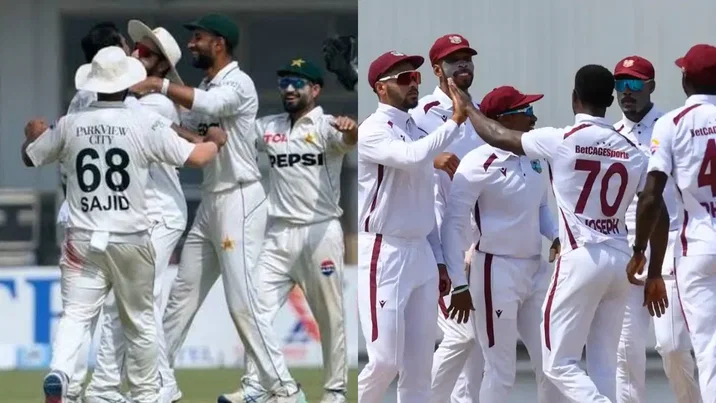
For decades, West Indies and Pakistan were bound by more than memorable Test contests. Both built their identity around fast bowling, producing generations of quicks who could win matches on their own. But the recently concluded Test match in the Caribbean highlighted how differently the two nations have evolved.
West Indies sealed the series with a dominant victory in Tarouba, and their fast bowlers once again played the leading role. Jayden Seales claimed another five-wicket haul against Pakistan, continuing a remarkable record against the Asian side. Nearly a fifth of his Test wickets have now come against Pakistan, underlining his growing stature as one of the world’s most promising young seamers.
Seales has become part of a pace attack that has consistently delivered in Test cricket. Alongside Kemar Roach, Alzarri Joseph and Shamar Joseph, he represents a bowling unit that has continued to prioritise the longest format despite the lure of franchise cricket.
West Indies’ Investment in Test Cricket
The numbers tell the story.
Since making his Test debut in 2021, Seales has become one of the leading wicket-takers among fast bowlers in the format. Roach recently became the first West Indies bowler since Curtly Ambrose to reach 300 Test wickets, while Shamar Joseph announced himself with his match-winning spell at the Gabba earlier this year.
What stands out is their quality and commitment as well. At a time when discussions about players ditching Test cricket to tour the T20 franchise circuit automatically conjures up images of West Indian cricketers, their first choice pace attack has put Test cricket front and centre.
That commitment has helped preserve one of the country’s strongest traditions even during a period when West Indies have struggled for consistency as a team.
Pakistan’s Changing Identity
Pakistan’s attack, meanwhile, has taken a different path.
Mohammad Abbas remains one of the most skilful seam bowlers in world cricket, but he often finds himself leading an attack short on genuine pace. In previous generations, bowlers like Wasim Akram, Waqar Younis, Shoaib Akhtar and Mohammad Amir formed attacks built around speed and aggression.
Today, Pakistan’s pace resources appear thinner, with several fast bowlers prioritising franchise commitments over extended Test careers. The result is a noticeable shift in identity for a nation once feared for producing world-class quicks.
A Tale of Two Cricketing Cultures
West Indies and Pakistan have often shared similar stories in world cricket. Both have experienced financial challenges, declining influence and inconsistent results in recent years.
Yet their approach to fast bowling now sets them apart.
While West Indies continue to produce bowlers whose biggest achievements have come in Test cricket, Pakistan is still searching for the next generation capable of carrying forward their rich fast-bowling legacy.
Source: Cricinfo