



Lionel Messi’s relationship with Argentina was built over two decades, and for much of that time, it seemed to ask more of him than it gave back.
When Messi first emerged for Argentina, the comparison with Diego Maradona was almost unavoidable. Maradona had led the country to the 1986 World Cup, and Messi inherited the expectation that he would eventually deliver another World Cup to a football-mad nation. Every major tournament only intensified that pressure.
The disappointments began early. Argentina lost the 2007 Copa America final to Brazil, and seven years later Messi came within one match of winning the World Cup before Germany defeated Argentina 1-0 in extra time in Rio de Janeiro. The following two years brought another kind of pain: Chile beat Argentina on penalties in the 2015 Copa America final and repeated the result in the 2016 final.
That second defeat pushed Messi to a breaking point. After missing his penalty in the shootout, he announced that he was retiring from international football. At 29, he appeared to have decided that the Argentina shirt had given him enough disappointment.
He lasted only a month before returning.
That decision would eventually change everything. Argentina appointed Lionel Scaloni as coach, and over the next few years a new generation grew around Messi. The team that had repeatedly fallen short finally became capable of winning with him rather than simply asking him to rescue it.
In 2021, Argentina defeated Brazil in the Copa America final at the Maracana, giving Messi his first senior international trophy. The victory removed the most persistent criticism of his international career, but the World Cup remained unfinished business.
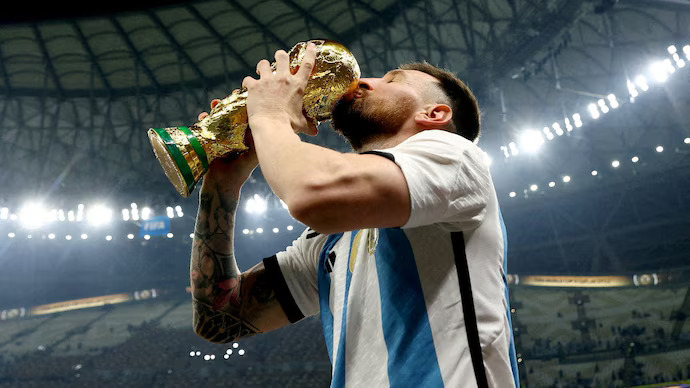
In Qatar, Argentina began with a shock defeat to Saudi Arabia before recovering. Messi scored against Mexico, Australia, the Netherlands and Croatia to take Argentina into the final, where France stood between him and the trophy. He scored twice in a 3-3 draw and then converted his penalty in the shootout as Argentina became world champions.
The Copa America title followed again in 2024, when Argentina defeated Colombia in the final. By then, Messi had gone from the player perpetually asked why he could not win for Argentina to the leader of the most successful period in the country’s recent history.
He returned for the 2026 World Cup, knowing that the end was approaching. Messi scored a hat-trick against Algeria and provided two assists in the semi-final against England as Argentina reached another final. This time, they fell short.
His decision to leave was also shaped by events away from football, particularly the death of his father Jorge. Messi had begun to feel that football no longer occupied the same place in his life, and the end of the 2026 campaign offered a natural point to step away.
After 21 years, 195 appearances and 125 goals, Messi leaves Argentina having completed the journey that once seemed impossible. He endured the finals they lost, walked away when the disappointment became too much, returned when he could not stay away, and eventually lifted the trophies that had defined his relationship with the national team.