




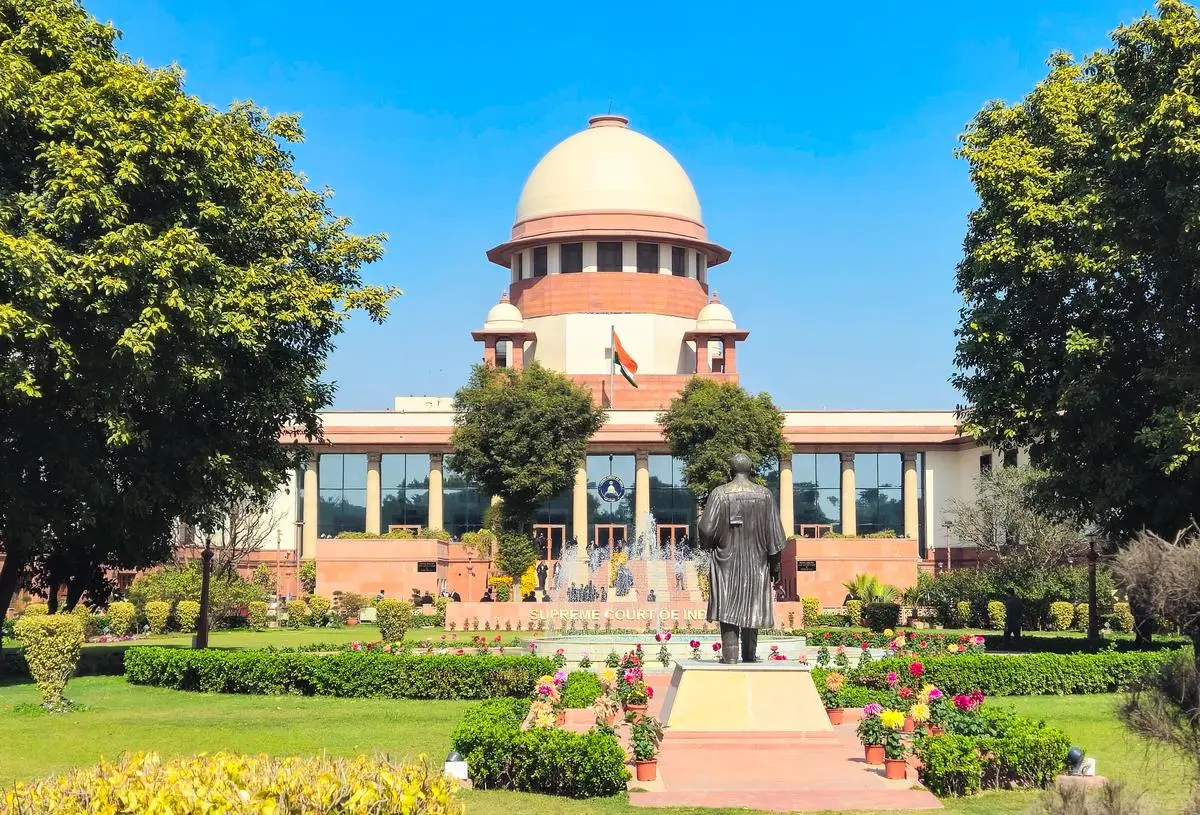
The Supreme Court has told the Centre that a “conscientious objector” should not face punishment for refusing to sing Vande Mataram, asking the government to keep in mind a 1987 judgment that protected children who declined to sing the national anthem on grounds of conscience.
A bench headed by Chief Justice of India Surya Kant was hearing a petition filed by Carnatic vocalist T.M. Krishna, challenging a new law mandating the singing of all six stanzas of Vande Mataram. Krishna has argued that the song’s last four verses, which invoke Hindu deities, violate the secular character of the nation. The bench, which also included Justice Joymalya Bagchi and Justice V. Mohana, sought the Centre’s response within two weeks and said the principle laid down in the Bijoe Emmanuel vs State of Kerala case should govern the amended law, which gives Vande Mataram the same status as the national anthem, Jana Gana Mana.
The amended Section 3 of the Prevention of Insults to National Honour Act, 1971, provides for imprisonment of up to three years, a fine, or both, for anyone who intentionally prevents the singing of the national anthem or national song. The court observed that while there was no dispute over Vande Mataram’s status as the national song, there should be no penal consequences for refusing to sing it. Justice Bagchi clarified that the court would not interfere with the decision to designate it as the national song, but would examine the issue of penal consequences.
CJI Kant remarked that Vande Mataram has long been understood as the national song, while the bench noted that a person should be free to decide whether to sing one stanza or all four, without facing penal action, in line with the precedent set in Bijoe Emmanuel. In that 1987 case, the Supreme Court had ruled that freedom of speech includes the right to remain silent, and that children could not be compelled to sing the national anthem, provided they stood respectfully during its rendition.
Senior advocate S. Muralidhar, representing Krishna, argued that mandating the singing of all stanzas under penal sanction transforms a contested historical symbol into compelled orthodoxy, and could send a signal of majoritarian religious alignment. He also pointed out that the term “national song” remains undefined in the amended Act, and that the underlying office memorandum has not even been gazetted. Solicitor General Tushar Mehta, representing the Centre, pushed back during the hearing, prompting objections from Muralidhar.
(Source: The Telegraph)