




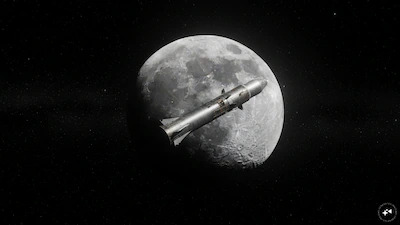
A four tonne section of a SpaceX Falcon 9 rocket is expected to collide with the Moon after spending more than a year drifting through space. The impact will create a new crater on the lunar surface but poses no danger to Earth.
The object is the second stage of a Falcon 9 rocket that launched Firefly Aerospace’s Blue Ghost lunar lander toward the Moon in January 2025. After delivering its payload, the stage exhausted its remaining fuel and could no longer be controlled. Because lunar missions require greater velocity than missions closer to Earth, the rocket stage remained in space instead of re-entering Earth’s atmosphere.
Earlier this year, astronomers determined that the discarded rocket body was on a trajectory that would eventually intersect with the Moon. It is expected to strike near Einstein crater at approximately 5,400 miles per hour, or about 8,690 kilometres per hour.
According to NASA, the collision will produce a crater measuring roughly 18 metres across and four metres deep. The impact will also eject dust and rock across the lunar surface. Scientists believe the dust plume may be illuminated by sunlight, although it is unlikely to be visible from Earth without specialised equipment.
NASA plans to capture images of the impact site before and after the collision wherever possible. Researchers hope the observations will improve understanding of artificial impacts on the Moon and help refine methods used to monitor and track large objects travelling through space.
Accidental impacts involving discarded rocket stages are rare. In 2022, a Chinese rocket stage struck the Moon after completing a lunar test mission. NASA also intentionally crashed a rocket stage into the Moon in 2009 to study the material thrown into space by the collision.
As governments and private companies increase the number of lunar missions, researchers expect opportunities like this to provide valuable information about the Moon’s surface and the long term behaviour of spacecraft hardware operating beyond Earth orbit.