




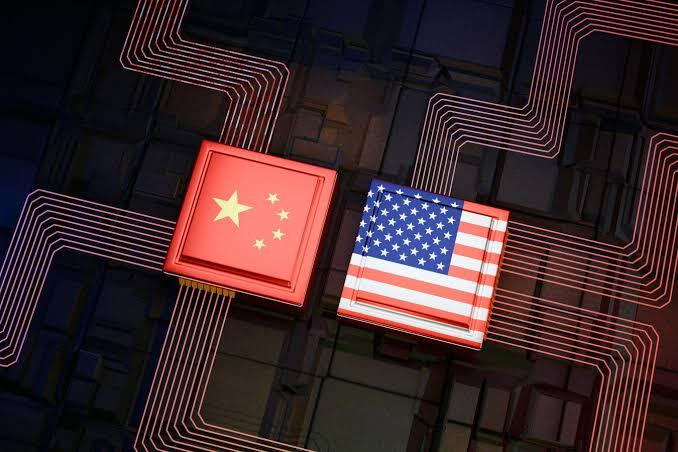
The global competition between the United States and China over artificial intelligence is entering a new phase, where technological leadership is increasingly shaped by export controls, semiconductor access, regulation and national security rather than AI models alone.
The latest development comes from Beijing-based startup Z.ai, whose newly released AI model, GLM-5.2, has attracted attention from researchers and technology leaders for reportedly delivering performance comparable to leading American models at significantly lower costs. The release has reignited debate over whether China is steadily narrowing the gap with the United States despite years of restrictions on access to advanced semiconductor technology.
For several years, Washington has tightened export controls on high-end AI chips and semiconductor manufacturing equipment in an effort to limit China’s ability to develop frontier AI systems. Those restrictions have made access to advanced Nvidia processors and cutting-edge chipmaking technology a central part of the broader strategic competition.
The rivalry has intensified in recent weeks through a series of separate developments. Anthropic temporarily suspended global access to some of its most advanced AI models after complying with US government restrictions before partially restoring access days later. Meanwhile, US officials reportedly questioned whether restricted semiconductor equipment had reached China, while Anthropic separately accused Alibaba of improperly accessing one of its AI models.
Together, these incidents illustrate how the AI race increasingly extends beyond research laboratories into trade policy, supply chains and diplomatic relations.
Despite the growing rivalry, analysts argue that both countries retain different competitive strengths. The United States continues to lead in frontier AI research, foundation models and commercial AI ecosystems. China, meanwhile, has developed significant capabilities in manufacturing, industrial supply chains and increasingly competitive open-weight AI models.
As governments continue introducing new restrictions while companies invest hundreds of billions of dollars into AI infrastructure, the contest is becoming about far more than technological capability alone.
Control over chips, computing infrastructure, software, semiconductor equipment and access to advanced AI models is emerging as an equally important measure of strategic influence.
Rather than a race defined by a single breakthrough, the US-China AI competition is evolving into a broader contest over who controls the technologies, supply chains and regulatory frameworks that will shape the next generation of artificial intelligence.