




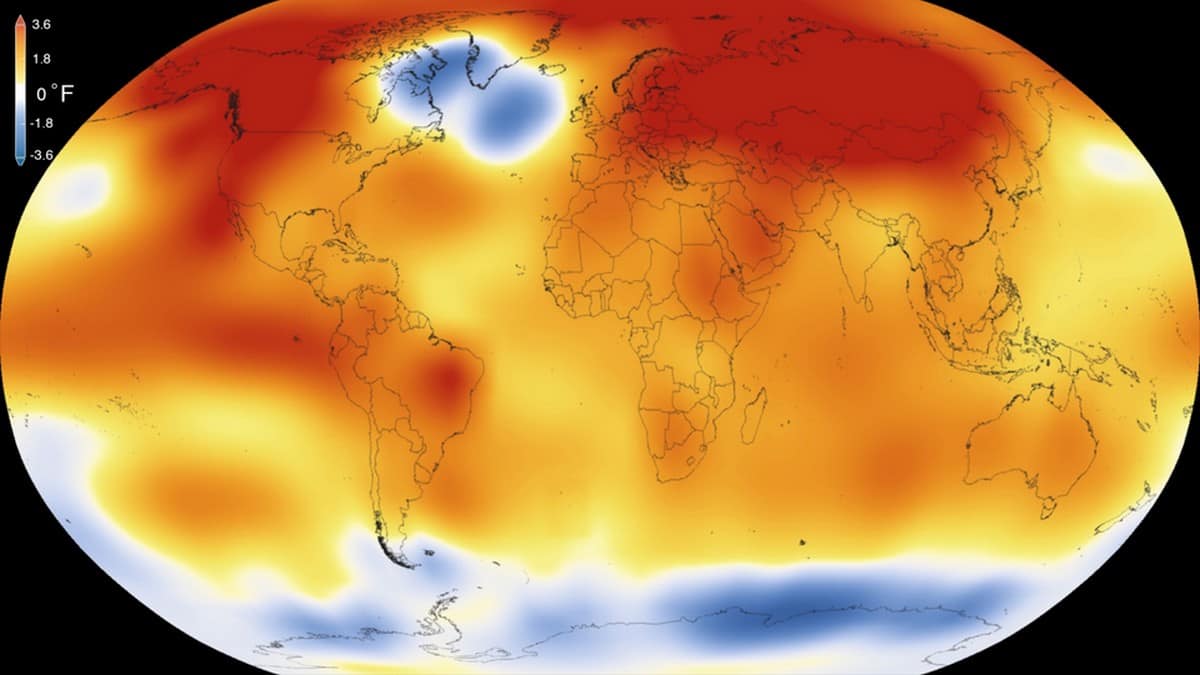
A mysterious cooling zone in the Atlantic Ocean is raising questions among climate scientists about how global warming actually works. While nearly every ocean region on Earth has grown warmer over the past hundred years, one patch of the North Atlantic—nicknamed the “cold blob” by researchers—has actually become colder. This unusual reversal has puzzled scientists for years, and they are still working to understand what mechanism keeps this area cool when almost everything else is heating up.
The cold blob sits in the North Atlantic Ocean, an area that would normally be expected to warm along with the rest of the planet as greenhouse gases trap more heat in the atmosphere. Yet satellite data and ocean measurements consistently show this region cooling or staying unusually cold compared to historical averages. According to reporting by Firstpost, scientists have been studying this phenomenon intensely, looking for explanations that fit with established climate science.
One leading theory involves ocean currents. The Atlantic Meridional Overturning Circulation—a massive system of moving ocean water sometimes compared to a conveyor belt—normally carries warm water northward from the tropics and cold water southward from the poles. If this circulation has weakened, it could explain why the North Atlantic isn’t warming as expected. A weaker conveyor belt would transport less heat toward that region, keeping it cooler than surrounding areas.
Another explanation scientists are investigating focuses on Greenland. As the massive ice sheet melts due to warming temperatures, enormous amounts of fresh water pour into the North Atlantic. Fresh water is lighter than salt water, so it can disrupt the normal mixing and circulation patterns. This disruption could prevent warm water from reaching certain areas, creating a persistent cold zone. The timing fits—rapid Greenland melting has accelerated over recent decades, roughly matching the period when the cold blob became most prominent.
Some researchers have also examined whether atmospheric patterns play a role. Shifts in weather systems over the North Atlantic could influence how much cold air moves down from the Arctic or how ocean water mixes at the surface. However, none of these explanations alone fully accounts for the cold blob’s behavior, which is why scientists continue investigating.
Why this matters extends beyond curiosity. Ocean currents are not just water moving around—they are critical regulators of climate. The Atlantic circulation system influences weather patterns across Europe, North America, and even Africa. If this system continues to weaken, it could alter hurricane tracks, change precipitation patterns, and affect how quickly storms develop. Coastal communities that depend on predictable weather would face new risks.
Ocean currents also determine where nutrients flow and where fish populations thrive. Disruptions to normal circulation patterns can harm commercial fisheries and shift marine ecosystems in unpredictable ways. For countries whose economies depend on ocean resources, these changes carry serious economic consequences.
The cold blob also challenges simple narratives about climate change. While global warming is real and driven by human activity, the planet’s climate system is far more complex than a simple uniform heating process. Different regions respond differently to the same greenhouse gas increases. Some areas warm faster, some slower, and occasionally an area like the North Atlantic seems to go the opposite direction. This complexity makes climate prediction harder and underscores why scientists must study regional variations carefully.
Scientists emphasize that the cold blob does not contradict climate change science or suggest that global warming is slowing down. Global temperatures continue rising, and the oceans overall continue warming. The cold blob is an exception that exists within this larger warming trend. However, if it signals a fundamental weakening of the Atlantic circulation—sometimes called the Atlantic Meridional Overturning Circulation or AMOC—the implications could be significant for decades to come.
Researchers remain cautious about drawing permanent conclusions. Cold and warm patches have appeared in the Atlantic before in Earth’s history. Current data does not yet prove that the cold blob represents a permanent shift in ocean circulation. However, the fact that this cooling has persisted for over a century during a period of rapid global warming makes it deserving of serious scientific attention. Understanding this anomaly helps researchers build better climate models and predict how ocean systems might change in the coming decades.
Source: Firstpost