



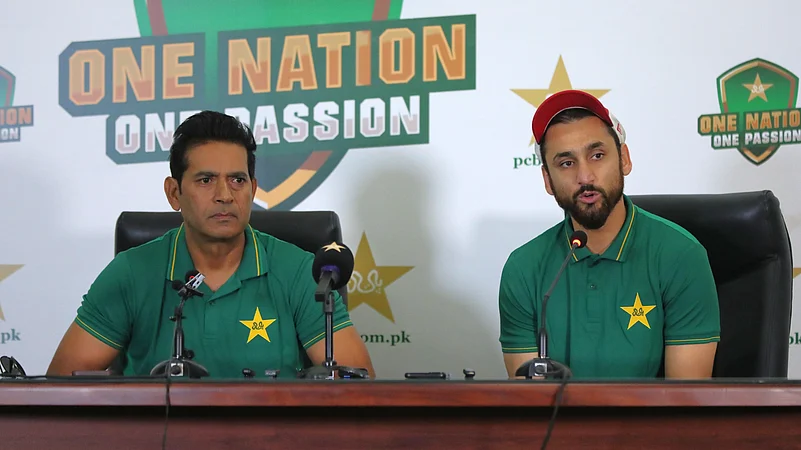
A few weeks ago, PCB director Aaqib Javed was asked how long it would take to fix Pakistan cricket. He had no answer.
The question was not complicated. A reporter at a press conference asked the one thing Pakistani cricket fans have been asking for years: how long will it take? Javed, who took over as Pakistan’s cricket director after the Champions Trophy debacle, admitted there is “no timeline.” That admission, delivered plainly and without spin, may be the most honest thing a Pakistani cricket official has said in years. It is also the most revealing. Because the reason Javed cannot offer a timeline is not that the problems are too big. It is that the solution Pakistan keeps reaching for is the same thing that created the crisis in the first place.
Every time Pakistan cricket has faced a setback, the response has followed the same script: change the captain, change the coach, change the chairman, restructure the contracts, overhaul the selection committee. The fix for instability has always been more change. And more change has become the instability. That loop — not any single event, not any single player, not any single administration is what Javed cannot put a timeline on. You cannot schedule the end of a cycle you are still repeating.
The roots of the decline trace back to the mid-1990s, but the warning signs were specific rather than dramatic. Pakistan’s fast-bowling pipeline, once the most feared in world cricket, stopped consistently producing successors to Wasim Akram, Waqar Younis and Shoaib Akhtar. The domestic structure that had fed world-class pace into the national team for two decades began thinning without a visible replacement system. Captaincy became a revolving door rather than a long-term leadership investment. Senior players were dropped and recalled based on short-form windows rather than team-building cycles. None of this made headlines at the time. The decline was not a collapse. It was administrative, quiet, and cumulative.
Then came setbacks that no cricket board, however competent, could have fully controlled. In 2009, a terrorist attack on Sri Lanka’s team bus in Lahore forced Pakistan to play its home cricket in the UAE for nearly a decade. The team lost the emotional and tactical advantage of home conditions, and international teams grew wary of touring. A year later, the Lord’s spot-fixing scandal involving three Pakistani players severely damaged the team’s credibility on the global stage. Pakistan cricket entered the 2010s carrying reputational damage, no home ground, and a domestic system already weakened by years of neglect. The existing cracks suddenly became much harder to repair.
But the external shocks, painful as they were, are not what define the current crisis. The biggest problems came from within. Pakistan cricket has rarely enjoyed institutional stability at any level. The PCB has had four chairmen since 2021 alone. The team has gone through seven head coaches in four years. Captaincy changes have become routine rather than exceptional. Selection committees have been formed, dissolved, and reformed with little continuity in philosophy or personnel. Most recently, the PCB scrapped its traditional tier-based central contracts and introduced a format-based system where player earnings depend on the formats they play rather than a single category. The reform may be sensible in isolation. But it arrives in a context where constant structural change has rarely delivered lasting improvement. Each new reset promises a fresh start. Each fresh start erases whatever continuity the previous one had barely begun to build.
The latest captaincy change captures the pattern in miniature. Shan Masood won just four of his sixteen Tests as captain before being replaced by Babar Azam — less than two years after Babar himself had stepped down from the role. The team’s answer to a leadership problem was to reinstall the leader whose departure created the vacancy in the first place. Pakistan has repeatedly searched for new captains, but changing individuals has not addressed the deeper issues in governance, planning and institutional memory that make every captain’s job nearly impossible regardless of who holds it.
The results now reflect the accumulated instability. At the Champions Trophy 2025, Pakistan were eliminated in the group stage as hosts — a humiliation that prompted the latest round of administrative upheaval. The team suffered its first-ever Test series defeat to Bangladesh. ODI series losses followed in New Zealand. Pakistan have not won an ICC title since the 2017 Champions Trophy. None of these outcomes happened because Pakistan fielded bad cricketers. The country continues to produce talented players. They happened because a team that restructures its coaching, captaincy, selection and contract framework every few months cannot build the kind of collective rhythm and trust that tournament cricket demands. Individual performances still show up. Team continuity does not.
This is what Aaqib Javed was really admitting when he said there is no timeline. He was not conceding that Pakistan cricket is beyond repair. He was acknowledging, perhaps without fully articulating it, that the system is trapped in a loop where every crisis triggers a reset and every reset prevents the stability needed to avoid the next crisis. The country has never lacked cricketing talent. What it has lacked, for the better part of two decades, is the ability to leave a structure in place long enough for it to work. Coaches need time to build systems. Captains need time to build trust. Domestic pipelines need time to develop players. Selection committees need time to build a philosophy. None of that is possible when the cycle restarts every few months.
Restoring Pakistan cricket does not require another overhaul. It requires something the system has struggled to maintain for years and shows no sign of learning how to protect: stability at every level, held in place long enough to actually be tested.
Source: Press conference remarks by Aaqib Javed, PCB