



Six matches into a new T20I cycle are hardly enough to define a team. Yet India’s tour of Ireland and England has revealed a recurring pattern that deserves attention.
On pitches offering extra bounce and larger square boundaries, India’s batting has repeatedly struggled against disciplined hard-length bowling. More importantly, the batters have found it difficult to score freely across all areas of the ground, allowing opposition bowlers to dictate terms.
England recognised those weaknesses early in the series. By the fourth T20I in Bristol, they had turned them into a blueprint.
England stuck to a simple plan
Having already troubled India with pace at Old Trafford and Trent Bridge, England produced another complete bowling display of the series in Bristol.
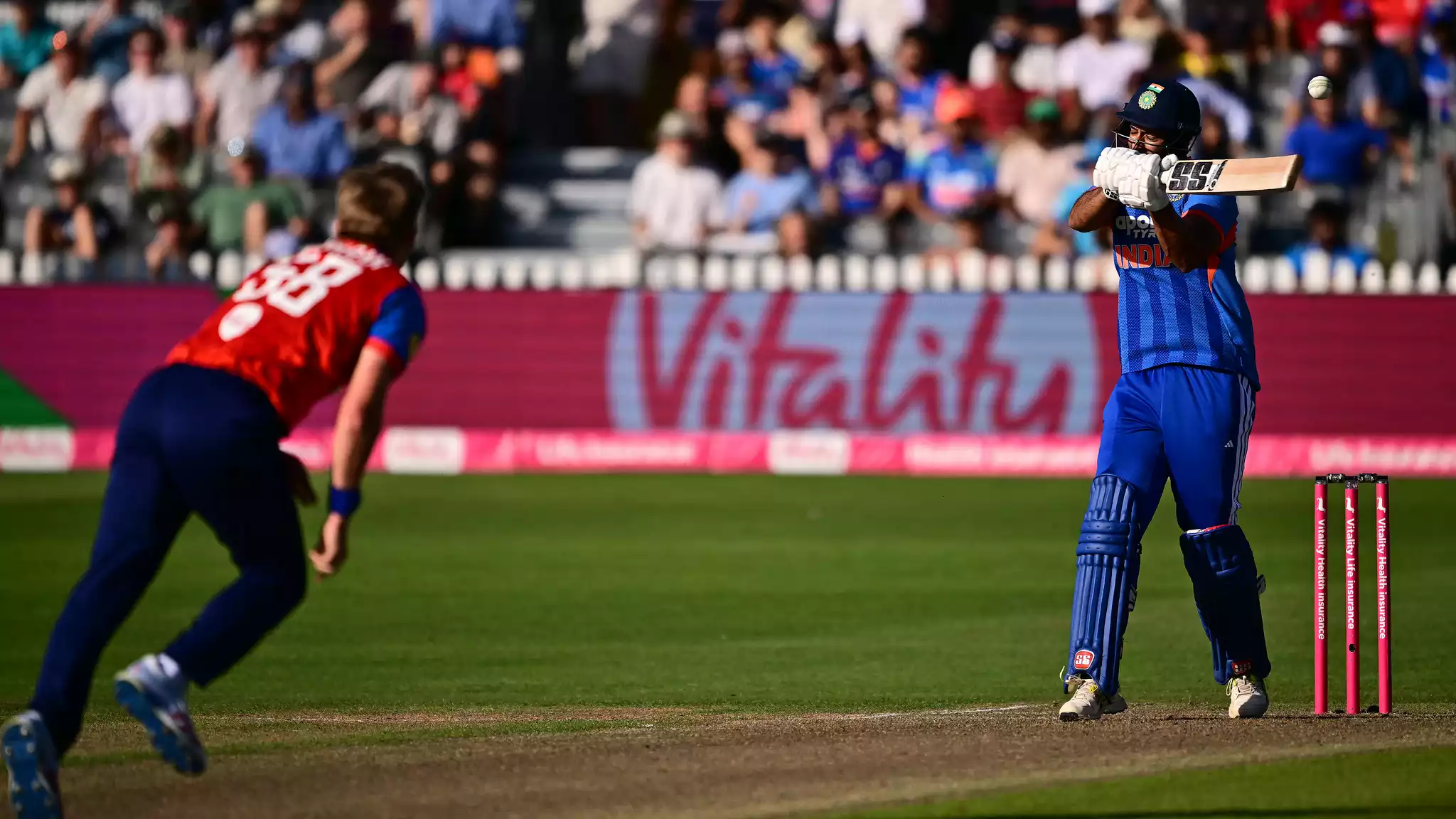
Jofra Archer and Josh Tongue relentlessly attacked hard lengths, occasionally mixing in fuller deliveries to prevent India’s batters from settling. Harry Brook complemented that strategy with attacking field placements, regularly keeping both square leg and deep backward square leg in position to catch mistimed pulls and hooks.
The plan worked almost immediately.
Vaibhav Sooryavanshi and Ishan Kishan both fell attempting cross-batted strokes inside the Powerplay, while Abhishek Sharma became the third batter to perish playing a similar shot after Adil Rashid was introduced.
While Indian batters heavily relied on the leg side against pace, England scored far more freely behind square and straight down the ground, making it much harder for India’s bowlers to contain them.
Against pace, India managed just 10 runs towards fine leg and four through mid-on, compared to England’s 26 and 20 respectively. England also outscored India significantly at backward point (15 to 2), showing how effectively they accessed different parts of the field instead of relying on one scoring option.
Brook’s captaincy made the difference
England’s bowling plans were backed by equally smart captaincy.
Brook refused to allow India’s batters to settle against either pace or spin, ensuring there were never more than three consecutive overs from the same bowling type.
When Abhishek Sharma and Ishan Kishan looked comfortable against pace, Will Jacks was introduced immediately. As soon as Shivam Dube arrived, Archer and Tongue returned to test him with extra bounce.
The match-ups worked perfectly.
Jacks finished with 1 for 28 from his four overs, using clever variations in pace rather than outright turn. His deliveries ranged from 77 kph to 99 kph, constantly forcing India’s batters to adjust.
India’s spinners, in contrast, offered very little variation. Even after being attacked, they continued bowling quicker through the air, allowing England’s batters to line them up more comfortably.
India failed to adapt
England’s bowlers didn’t simply rely on pace. As the ball got older, Archer and Tongue repeatedly took pace off the surface, while Sam Curran mixed yorkers with slower balls to deny India any late acceleration.
The execution was outstanding. England’s seamers conceded just 17 runs in the final three overs, allowing only one boundary. Of the 10 slower deliveries bowled by Archer, Tongue and Curran, India managed only four singles while losing Tilak Varma and Washington Sundar.
India also struggled to exploit Bristol’s shorter straight boundaries.
Against England’s pace attack, they failed to hit a single boundary straight down the ground. Fifteen attacking strokes in that region produced only seven runs.
England, meanwhile, struck four boundaries, including two sixes, through the same area.
Even against spin, Indian batters were unable to capitalise on fuller deliveries, scoring just 13 runs from 11 balls pitched four metres or fuller, with only one boundary.
A concern beyond one series
India eventually finished on 158, well below Bristol’s average first-innings T20I score of 206 since 2022. England chased the target comfortably, but the contest had effectively been decided much earlier.
Across 20 overs, England combined hard lengths, pace variation, proactive captaincy and intelligent field placements to expose the same weaknesses that had troubled India throughout the tour.
One poor series doesn’t define a team. But repeated patterns often reveal areas that demand attention.
With the 2028 T20 World Cup cycle now underway, India’s biggest challenge is to become more adaptable.