



For decades, India has been regarded as cricket’s biggest talent factory. Every year, thousands of players compete across domestic tournaments, dreaming of wearing the India jersey. But in recent years, another trend has quietly emerged. An increasing number of international cricketers representing countries such as the USA, Oman, the UAE, Canada, the Netherlands and even New Zealand began their cricketing journeys in India.
The phenomenon reflects more than just individual career choices. It highlights how India’s unmatched depth has started influencing the global game.
India’s extraordinary depth
The obvious explanation is that these players were unable to break into Team India. While there is some truth to that, it tells only part of the story. India produces far more international-quality cricketers than a single national team can accommodate.
Every season, the Ranji Trophy, Syed Mushtaq Ali Trophy, Vijay Hazare Trophy and the IPL uncover fresh talent, yet only a handful of players earn national selection. For many, the challenge is not becoming good enough for international cricket, but becoming one of India’s best 15.
Different routes to the same destination
Unlike in the past, missing out on Team India no longer has to end an international career. Some players migrate abroad with their families at a young age and develop through another country’s cricket system. Others first pursue domestic cricket in India before moving overseas for work, higher education or better opportunities while continuing to play the game competitively.
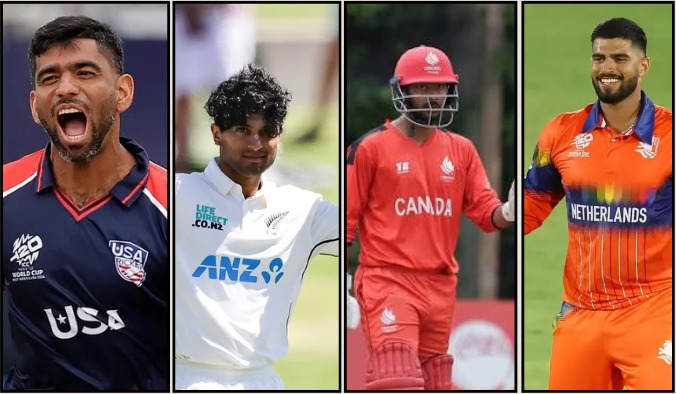
These two pathways are visible across international cricket. Ajaz Patel, Ish Sodhi and Rachin Ravindra built their careers in New Zealand after emigrating early in life. On the other hand, players such as Saurabh Netravalkar, Harmeet Singh, Monank Patel and Milind Kumar first tried to establish themselves in Indian cricket before eventually representing the United States.
The countries benefiting the most
The trend extends well beyond one or two countries. The USA has built a strong core around players like Monank Patel, Saurabh Netravalkar, Harmeet Singh, Milind Kumar, Unmukt Chand. Oman’s squad features Vinayak Shukla, Jatinder Singh and Kashyap Prajapati, while the UAE has Harshit Kaushik, Simranjeet Singh, Dhruv Parashar, Aryansh Sharma, Rahul Chopra. Canada, the Netherlands and New Zealand also have several Indian-born or Indian-origin cricketers, and the list continues to grow.
Why the trend is accelerating
This rise has coincided with the rapid development of Associate cricket. Professional leagues such as Major League Cricket in the USA, ILT20 in the UAE and Global T20 Canada have created opportunities that barely existed a decade ago. Better domestic structures, more international fixtures and stronger financial incentives have made representing Associate nations a far more attractive proposition.
Brain drain or a sign of India’s strength?
Calling this a “brain drain” for Indian cricket would be misleading. Most of these players were not on the verge of regular India selection. Instead, they were competing in the deepest talent pool in world cricket. Without alternative pathways, many might never have experienced international cricket at all.
A global impact
Perhaps the best example came during the 2024 T20 World Cup, when USA fast bowler Saurabh Netravalkar dismissed Virat Kohli. It was a symbolic moment: two cricketers whose journeys began in India’s cricket ecosystem meeting on opposite sides of an international contest.
As cricket continues to expand globally, India’s influence extends well beyond its own national team. Its domestic system has become a launchpad for international careers across continents, helping strengthen Associate nations and making world cricket more competitive. The growing presence of Indian-born and Indian-origin players across international teams is not simply a reflection of migration. It is evidence of the remarkable depth and reach of India’s cricket ecosystem.